History of the Garden
In 2016, the garden behind The Hunt Museum was officially opened to the public, although the railings initially remained in place. By the summer of 2020, with the assistance of UMR, a local recycling company, the railings were removed, creating a more open and inviting space.
During the Garden Design Competition, the OPW conducted a detailed tree survey that identified the Pink Chestnut tree as severely diseased and posing a safety hazard. This diagnosis was corroborated by two further surveys, leading to the decision to remove the tree. To ensure the stability of the surrounding area and safeguard the roots of neighbouring large trees, the lower trunk and root system were carefully left in place.
On 29 September 2020, an independent contractor, on behalf of the OPW, carried out an additional survey to assess the condition of all trees and recommend any necessary actions. For more details and to view the full survey results, please click here.
Following public consultation, there was a strong desire to transform the remaining tree stump into a meaningful sculpture for the garden, adding a new creative element to the space.
The concept of creating a “museum in a garden” stemmed from a desire to break down the perceived barriers to entering the building. By bringing the museum’s objects into the public domain, the garden becomes a welcoming and accessible extension of the museum experience.


Museum in a Garden
Three finalists and a public consultation later, the judges of the Hunt Museum Garden Design Competition decided on Nicola Haines’s amazing community influenced garden for the Hunt Museum. Museum in a Garden was designed by Nicola Haines of Tierney Haines Architects, who won the public competition. The design draws on the maritime connections of the building and museum collection by creating ‘tide lines’ of grass and planting that ebb and flow around the garden, creating alcoves of shelter for exhibition space, seating and play. Exhibition alcoves are planted to give a flavour of the geographical origin of the escaped, enlarged museum objects.
Following a rigorous selection process and public consultation, the judges of the Hunt Museum Garden Design Competition chose Nicola Haines’s exceptional, community-inspired design for the Hunt Museum. Nicola Haines, of Tierney Haines Architects, won the public competition with her vision for Museum in a Garden.
Her design takes inspiration from the building’s maritime history and the museum’s collection, incorporating flowing “tide lines” of grass and plants that ebb and weave throughout the garden. These natural curves create inviting alcoves for exhibition spaces, seating, and play areas. The exhibition alcoves are uniquely planted to reflect the geographical origins of the enlarged and “escaped” museum objects featured within the garden.
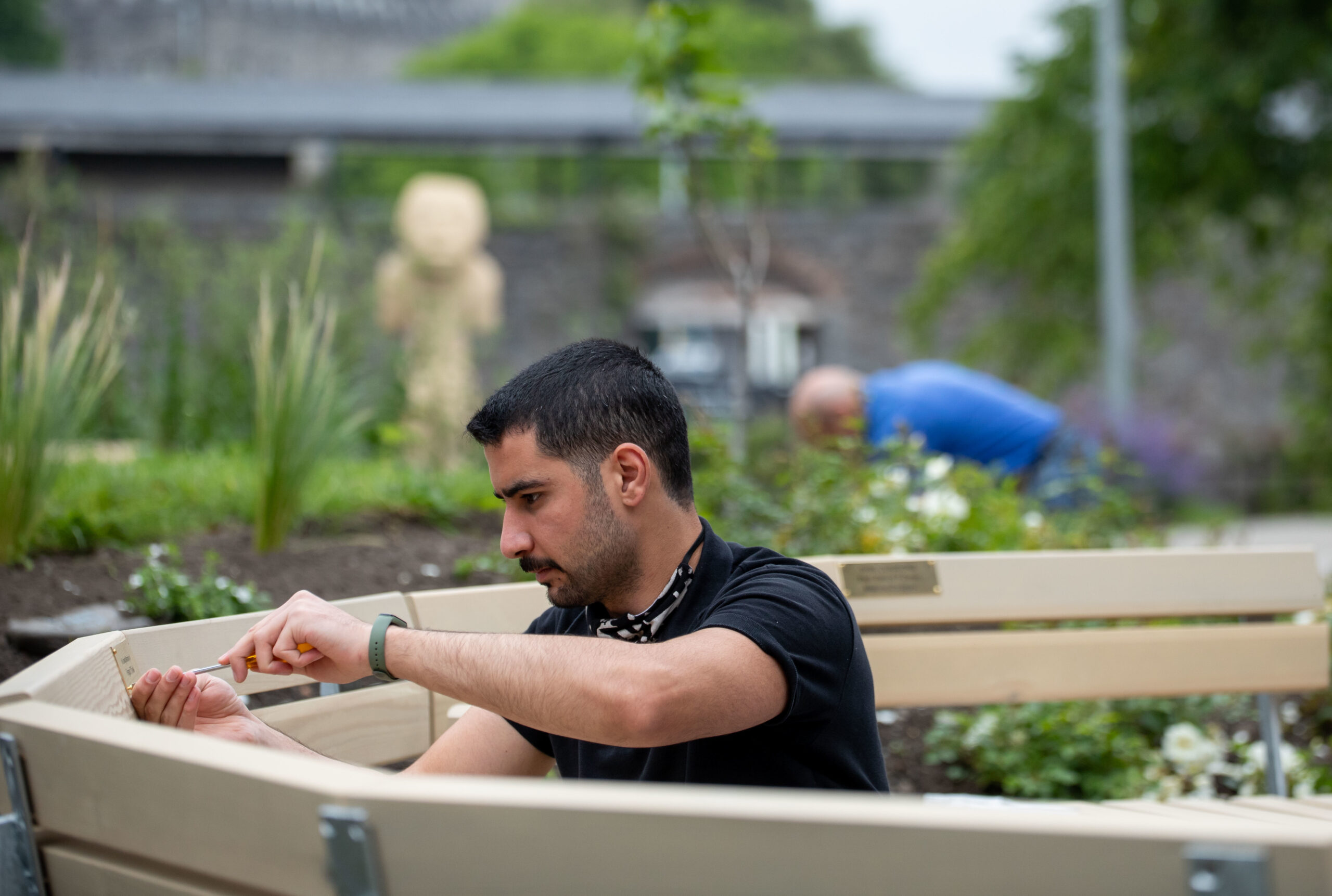
The local community, including volunteers with lived experience of mental health challenges, collaborates with professionals to maintain the garden, fostering a vibrant and welcoming green space for everyone to enjoy. Many volunteers find working in the garden particularly calming and deeply rewarding, taking great pride in the opportunity to immerse themselves in hands-on activities.
It has areas for quiet reflection, for community activity, for games and for eating and drinking. It is fully accessible for the physically disabled and has a sensory garden with plants for touching and smelling.
Opened officially on 24 June 2021 by Eanna Ní Lamhna and is a result of some generous donations and our 2020 Fund-a-Cobble fundraiser.


Picture: Alan Place

Picture: Alan Place
The Sculptures
Using the technologies of 3D scanning and 3D printing, the artefacts “hidden” within the museum, are made large and placed outside the walls of the museum for play and enjoyment.
Olmec Man
Our first sculpture to be installed was Olmec Man. The Olmec were one of the earliest civilisations in Mesoamerica. modern-day Mexico. Pre-dating the Aztecs and the Maya, the Olmec were great craftspeople and artists who appear to have had elaborate burial rites. Olmec Man is similar to sculptures found in a burial at the Olmec city La Venta, which flourished between c. 900 – 400 BC.
This sculpture is made of Tricoya, an Irish durable and sustainable wood-based product from a 3D scan that was enlarged and then machined using computer numerical control (CNC).
The creation of Olmec man was a collaboration between Arup, Transition Year students of Ardscoil Mhuire and Coláiste Chiaráin. MONARÚ aided by a grant from the ESB.
We also need support to produce more of our 3D Museum Replicas, or to encourage sculptors to create new pieces for the remaining six plinths in the garden. If you can donate €250 or more we can claim the 31% tax relief, making your donation worth nearly a third more. As well as more sculpture we want to improve lighting and disabled access and use of the garden.


The garden will feature super-sized sculptures replicating artefacts from the museum. First to be installed is Olmec Man, a Mexican artefact that was digitised by TY students and made into a two-metre outdoor replica using 3D printing technologies with help from ESB, Arup, the Limerick School of Art & Design (LSAD) and Monaru.ie. Picture: Alan Place


Picture: Alan Place


Picture: Alan Place


Picture: Alan Place
Etruscan Jug, June 2022
Takumi have used their know-how and engineering skills to add a new sculpture to the Hunt Museum in a Garden. Takumi engineers and designers have made an interpretation of the museum’s Etruscan Wine Jug from the 5th century BC, using Corten Steel, cut by water jet and welded into shape.
This sculpture is a reproduction of an original 26 cm tall Etruscan jug, known as an oinochoe, a mixture of the Greek words oînos, “wine” and khéō, “I pour.” This typical Etruscan vessel is likely to have originated near Vulci, on the West coast of Italy. Such jugs were popularly exported and often found in princely Celtic graves.
Takumi developed and manufactured this sculpture using a 3D photogrammetry model created by the Hunt Museum Volunteer Digitisation Group and rendered with help from MONARÚ. The Beaked Flagon complements existing sculpture Olmec Man which was designed by ARUP and produced by Monarù, financed by a grant from ESB.


No Repro Fee
pictured as Takumi added a new sculpture to the Hunt Museum in a Garden. Takumi engineers and designers made an interpretation of the museum’s Etruscan Wine Jug from the 5th century BC, using Corten Steel, cut by water jet and welded into shape.
Pic. Brian Arthur


No Repro Fee
pictured as Takumi added a new sculpture to the Hunt Museum in a Garden. Takumi engineers and designers made an interpretation of the museum’s Etruscan Wine Jug from the 5th century BC, using Corten Steel, cut by water jet and welded into shape.
Pic. Brian Arthur


No Repro Fee
pictured as Takumi added a new sculpture to the Hunt Museum in a Garden. Takumi engineers and designers made an interpretation of the museum’s Etruscan Wine Jug from the 5th century BC, using Corten Steel, cut by water jet and welded into shape.
Pic. Brian Arthur


No Repro Fee
pictured as Takumi added a new sculpture to the Hunt Museum in a Garden. Takumi engineers and designers made an interpretation of the museum’s Etruscan Wine Jug from the 5th century BC, using Corten Steel, cut by water jet and welded into shape.
Pic. Brian Arthur


No Repro Fee
pictured as Takumi added a new sculpture to the Hunt Museum in a Garden. Takumi engineers and designers made an interpretation of the museum’s Etruscan Wine Jug from the 5th century BC, using Corten Steel, cut by water jet and welded into shape.
Pic. Brian Arthur


No Repro Fee
pictured as Takumi added a new sculpture to the Hunt Museum in a Garden. Takumi engineers and designers made an interpretation of the museum’s Etruscan Wine Jug from the 5th century BC, using Corten Steel, cut by water jet and welded into shape.
Pic. Brian Arthur


No Repro Fee
pictured as Takumi added a new sculpture to the Hunt Museum in a Garden. Takumi engineers and designers made an interpretation of the museum’s Etruscan Wine Jug from the 5th century BC, using Corten Steel, cut by water jet and welded into shape.
Pic. Brian Arthur


No Repro Fee
pictured as Takumi added a new sculpture to the Hunt Museum in a Garden. Takumi engineers and designers made an interpretation of the museum’s Etruscan Wine Jug from the 5th century BC, using Corten Steel, cut by water jet and welded into shape.
Pic. Brian Arthur


No Repro Fee
pictured as Takumi added a new sculpture to the Hunt Museum in a Garden. Takumi engineers and designers made an interpretation of the museum’s Etruscan Wine Jug from the 5th century BC, using Corten Steel, cut by water jet and welded into shape.
Pic. Brian Arthur


No Repro Fee
pictured as Takumi added a new sculpture to the Hunt Museum in a Garden. Takumi engineers and designers made an interpretation of the museum’s Etruscan Wine Jug from the 5th century BC, using Corten Steel, cut by water jet and welded into shape.
Pic. Brian Arthur
Dodecahedron Sculpture, June 2023
The another addition to the Hunt Museum in a Garden was installed on Wednesday, 7th June 2023. The Dodecahedron Sculpture continues the tradition of partnering with local businesses to bring to fruition new sculptures in the garden.
This striking piece, a permanent feature in the Museum in a Garden, was designed and fabricated by Kirby Group Engineering. Impressed by the Etruscan Jug Sculpture produced by Takumi Precision Engineering, Kirby Group approached the museum From concept to realisation, the project took approximately eight months.
The sculpture is a representation of the Dodecahedron (pictured below), an object from the Hunt Museum Collection. Dodecahedrons are somewhat shrouded in mystery. There is a lack of agreement in terms of their use. Several theories have been put forth as to their use: a measuring device, a religious artefact, a candlestick holder, even children’s toys.


Kirby Group Engineers installing the Dodecahedron, June 2023


The Dodecahedron Sculpture, June 2023


The Dodecahedron Sculpture, June 2023


Dodecahedron | Metal,Copper Alloy,Bronze | 1st to 4th century AD | The Hunt Collection | PD
Un-BUG-lievable Festival, October 2024
The Un-BUG-lievable Festival was a family-friendly, community-focused event celebrating biodiversity and the often-overlooked world of insects. Held as part of the Creepy Crawlies: LOVE/HATE exhibition and the Museum in a Garden initiative, the festival took place in The Hunt Museum’s garden and was designed to bring people closer to nature through art, science, and hands-on activities.
The festival featured a variety of interactive events, including guided nature walks, insect-spotting tours, and creative workshops focused on the theme of insects and their habitats. Visitors were encouraged to explore the museum garden, learn about the vital role insects play in maintaining healthy ecosystems, and consider how they can contribute to preserving biodiversity.
A highlight of the festival was the collaborative sculpture project led by artists Nessa Darcy and Sophie von Maltzan. Through a series of four workshops, participants were invited to connect with nature and express their creativity by sculpting clay insects inspired by the local environment. These workshops aimed to encourage greater appreciation of the small creatures that are essential to our ecological balance and to foster community engagement through art.
The co-collaborative sculptures and accompanying workshops were designed to foster creativity, connection, and a sense of shared achievement within the community. The sculptures that now reside in the garden were made from fallen trees. They were designed by socially engaged environmental artist Sophie von Maltzan.
Some of the over 200 clay insects created by the local community through workshops with creative entomologist Nessa Darcy are attached to them. Making them a collective art work, created with the local community artists of all ages and abilities during the insect exploration and workshops with Nessa Darcy. During four workshops, held in September and October 2024, participants sculpted unique clay insects, inspired by the insects they found in the museum garden with Nessa, as well as their imagination and the theme of nature.
The timber sculptures will remain in the garden to invite children of all ages into the space and engage with them. During their slow decay over the next 10 years they will also be important hosts to many insects who thrive in dead wood.
Games in the Garden
The garden features a permanent chessboard along with a variety of other outdoor games, including quoits, boules, and croquet, all available to borrow. It’s a space designed to encourage creativity and engagement, hosting events like music performances, theatre, chess and boules tournaments, painting sessions, and even sand sculpture activities.
Be sure to check our What’s On section for the latest events and activities.


24.06.21.
The Hunt Museum, which exhibits one of Irelands greatest private collections of Art and Antiquities, has created an exciting new public space for Limerick. Museum in a Garden takes the Hunt Museum outside its walls to create a public urban garden in the heart of Limerick. The concept behind the garden is to break down barriers to culture and art and encourage greater engagement with the community.
Enjoying a game of rings at the opening of the Museum in a Garden, Hunt Museum Limerick was, Ellie McGlynn, 10, North Circular Road Limerick. Picture Alan Place.
Last year, The Hunt removed the railings around its green space to create the Museum in a Garden. Conceived as an extension to the museum, the garden will feature seven super-sized sculptures replicating artefacts from the museum. First to be installed is Olmec Man, a Mexican artefact that was digitised by TY students and made into a two-metre outdoor replica using 3D printing technologies with help from ESB, Arup, the Limerick School of Art & Design (LSAD) and Monaru.ie. Picture: Alan Place


24.06.21.
The Hunt Museum, which exhibits one of Ireland’s greatest private collections of Art and Antiquities, has created an exciting new public space for Limerick. Museum in a Garden takes the Hunt Museum outside its walls to create a public urban garden in the heart of Limerick. The concept behind the garden is to break down barriers to culture and art and encourage greater engagement with the community.
Enjoying a game of Croquet at the opening of the Museum in a Garden, Hunt Museum Limerick was Tom O'Sullivan, 10, Mungret Co. Limerick. Picture Alan Place.
Last year, The Hunt removed the railings around its green space to create the Museum in a Garden. Conceived as an extension to the museum, the garden will feature seven super-sized sculptures replicating artefacts from the museum. First to be installed is Olmec Man, a Mexican artefact that was digitised by TY students and made into a two-metre outdoor replica using 3D printing technologies with help from ESB, Arup, the Limerick School of Art & Design (LSAD) and Monaru.ie. Picture: Alan Place


24.06.21.
The Hunt Museum, which exhibits one of Ireland’s greatest private collections of Art and Antiquities, has created an exciting new public space for Limerick. Museum in a Garden takes the Hunt Museum outside its walls to create a public urban garden in the heart of Limerick. The concept behind the garden is to break down barriers to culture and art and encourage greater engagement with the community.
Enjoying a game of Chess at the opening of the Museum in a Garden, Hunt Museum Limerick were, Julie, 12 and Tom, 10 O'Sullivan, Mungret Co. Limerick. Picture Alan Place.
Last year, The Hunt removed the railings around its green space to create the Museum in a Garden. Conceived as an extension to the museum, the garden will feature seven super-sized sculptures replicating artefacts from the museum. First to be installed is Olmec Man, a Mexican artefact that was digitised by TY students and made into a two-metre outdoor replica using 3D printing technologies with help from ESB, Arup, the Limerick School of Art & Design (LSAD) and Monaru.ie. Picture: Alan Place


Picture: Alan Place
Join our Garden Team
We are always seeking enthusiastic volunteers to help with planting, weeding, and general garden maintenance. If you’re interested in lending a hand, please contact us at info@huntmuseum.com.
Alternatively, visit our Help in the garden Limerick section for more information on how to get involved.
For any other enquiries about the Museum in the Garden please email: info@huntmuseum.com


Some of the cobbles placed in the garden.


Sponsor a bench to remember loved ones.


Sponsor a bench to remember loved ones.


Buy an engraved cobble and dedicate it to a loved one.