Snap!
Have you seen a museum object that looks very like an object from another museum?
Have you seen a museum object that looks very like an object from another museum?
Just like the card game Snap! here we match objects from our collection to objects in other museums.
Museums have become object focused.
Less time is spent adding to the collection and more time is spent researching objects already in the museum collection.
New routes for inquiry have made researching museum objects easier.
Many museum collections and cultural heritage objects are open and in the public domain so comparisons and connections between different museum collections can be easily made.Here are some of recent discoveries...

Chinese Porcelain with Silver-Gilt Mounts | Hunt Museum | PD/ Trenchard Bowl | V&A | ©Victoria & Albert Museum, London /Two-handled bowl from Burghley House, Lincolnshire | Met Museum | PD
From the Hunt Collection this Ming dynasty, Wan Li (1573-1619) (Emperor Xian), porcelain bowl has distinctive Elizabethan silver mounts. The outside rim of the bowl is decorated with a flying horse border and the walls are decorated with flower sprays.
This Chinese porcelain bowl and similar examples would have been created for the European market, the gilt mounts possibly added once it arrived in Europe and appealing to the European aesthetic.

Silver-gilt mounted Chinese porcelain bowl | Ceramic, Porcelain, Metal,silver | 16th to 17th century AD | The Hunt Collection | PD
Chinese porcelain like this bowl tells an interesting story about the European obsession with Asian ceramics, especially porcelain and how they were so highly prized during the 16th century with large quantities of porcelain created for export into Europe.
The Trenchard bowl below (1599 -1600) is on display in the Victoria & Albert Museum and is similar in style to that of the Hunt collection. It is made of Jiajing porcelain with gilded silver mounts, that similarly were added in London once the bowl was imported. The pattern is made up of pomegranates in foliage. The rim is mounted with silver-gilt with straps running down to the mounted base. The handles are in the form of gilt mermen.

The Trenchard Bowl ©Victoria & Albert Museum, London
The two-handled bowl below is from The Met collection, it originated from Burghley House in Lincolnshire, it is very similar to the V&A example with similar Merman handles. The porcelain is decorated with hares, on the inside there is foliage and at its centre is a small rabbit or hare.
The hare or rabbit is a symbol of longevity on Ming dynasty objects, there is a Daoist legend that says a white hare or rabbit lives on the moon, whose job it is to grind the elixir for immorality.
It is suggested that William Cecil, Lord Burghley who was an adviser to Elizabeth I is associated with bowls of this type, fine porcelain and gilded silver handles and mounts.

Two-handled bowl from Burghley House, Lincolnshire | Porcelain | 16th century | Met Museum Collection | PD

Two-handled bowl from Burghley House, Lincolnshire | Porcelain | 16th century | Met Museum Collection | PD

This silver medallion from the Hunt Museum has been dated to the late medieval period between the 14th and 16th centuries. The style of dress of the two figures, the lady wears the escoffion or headdress that was worn by ladies of the court or those who were part of the royal family, the male figure wears a medieval headdress and houppelande with flaring sleeves. The male figure holds a wreath and the lady holds a puppy, they appear to be a garden. A banner above them reads In Gre.

Silver medallion/Silver/15th century or 16th century AD/The Hunt Collection/PD

Mirror Cover with two lovers/Ivory/The Walters Art Museum/c. 1410/CC0
Above is one of two very similar examples to the Hunt medallion, an ivory mirror case at The Walters Art Museum. This circular ivory carved piece illustrates many of the same symbolism and imagery, two medieval figures in a garden. Above their heads, the banner reads Prenes.
Together with the Hunt inscription, it would read Prenez En Gre, this could refer to the phrase found in the poetry of Christine de Pisan: Prenez en gre don de votre amant – Take kindly the gift of your lover

Valve de boîte à miroir OA 115/Ivory/15th century/Musée de Cluny/In copyright
The second example comes from Musée de Cluny le monde médiéval in Paris. This object is described as a valve of a mirror case, it is described as the counterpart of the example in the Walters Gallery. The scene carved on the this ivory disc is nearly a replica of the Hunt Collection example. See below for both examples side by side.

OA 115 Ivory Mirror Valve Musée De Cluny /Medallion from the Hunt collection

This stylized figure of a horse and rider was hand sculpted from clay that has then been fired. It is similar to other examples of Syro Hittite (Neo-Hittite) figures that date from the 2nd millennium BC. It is likely that such figures were used in ritual ceremonies. The features on the figurine are stylistically similar to examples from the British Museum and the Ashmolean Museum.

Syro Hittite figure of a horse and rider/Ceramic/2nd millennium BC (possibly)/The Hunt Collection/PD
Similar examples of clay figurines attributed to the Hittite culture are evident in many museums across the world, such as the example below from the British Museum. See how the rider holds the neck of horse and how the eyes are formed.

Baked clay model of horse and rider; |CC BY-NC-SA 4.0 |© The Trustees of the British Museum | Hittite Figure | Hunt Collection | PD / © Ashmolean Museum, University of Oxford (image, internal record shot)
The example below from the Ashmolean Museum illustrates much of the same style as the Hunt Hittite figure, here the animal is also a horse and similarly the rider's arms are holding the horse's neck. The rider has similar features, large circular eyes and pointed head.

Horse-and-rider figurine, © Ashmolean Museum, University of Oxford (image, internal record shot), Presented by Sir Leonard Woolley and T.E. Lawrence, 1914.

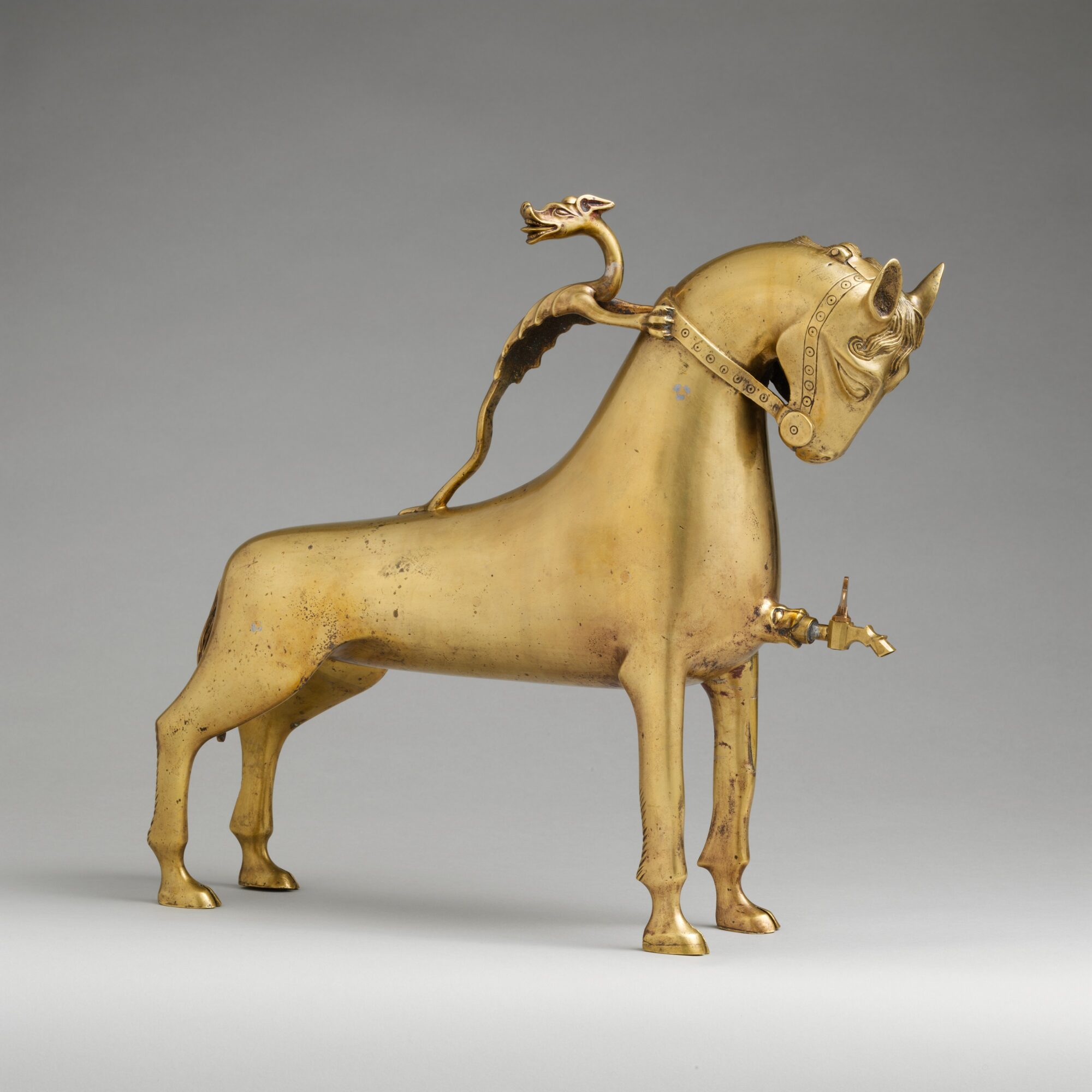
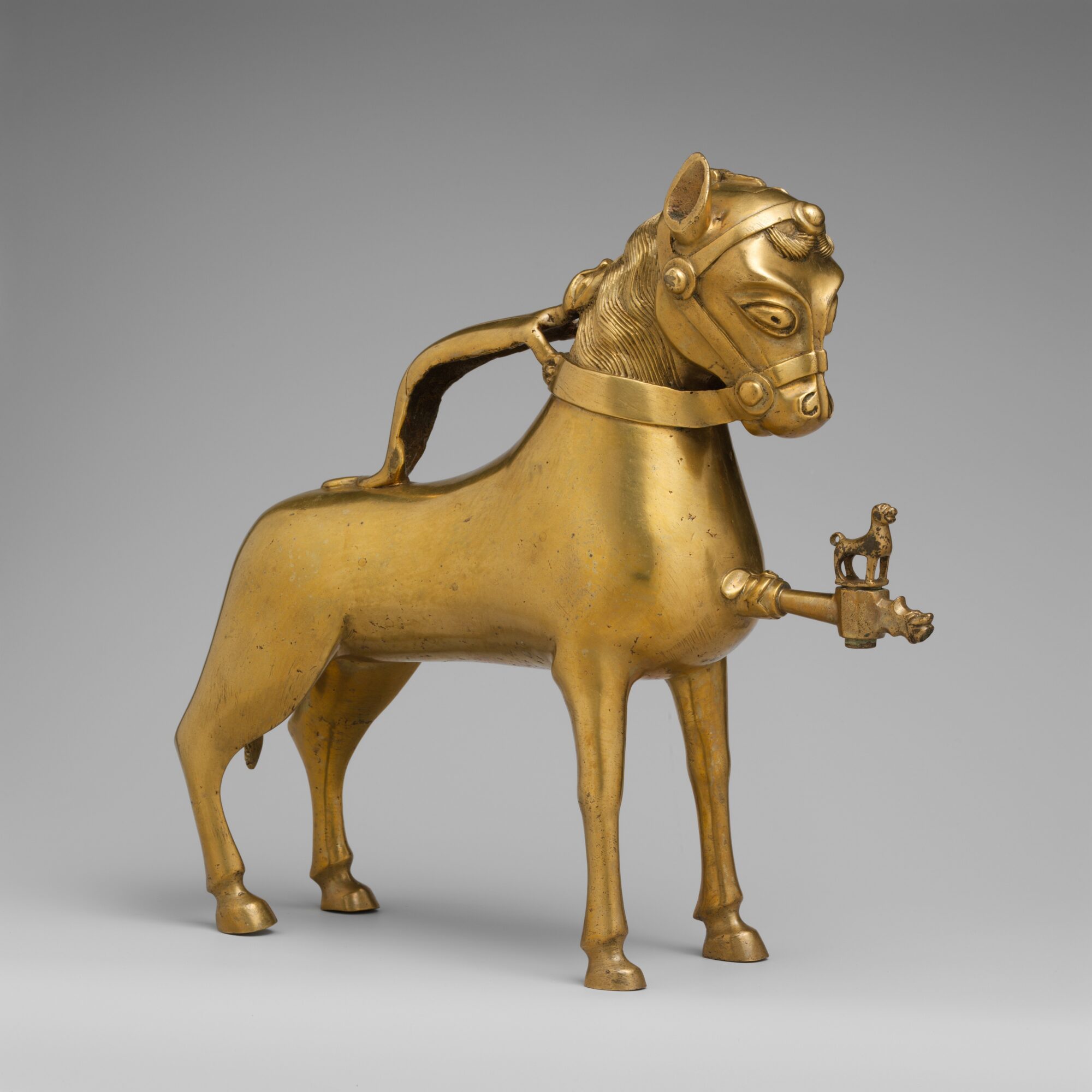
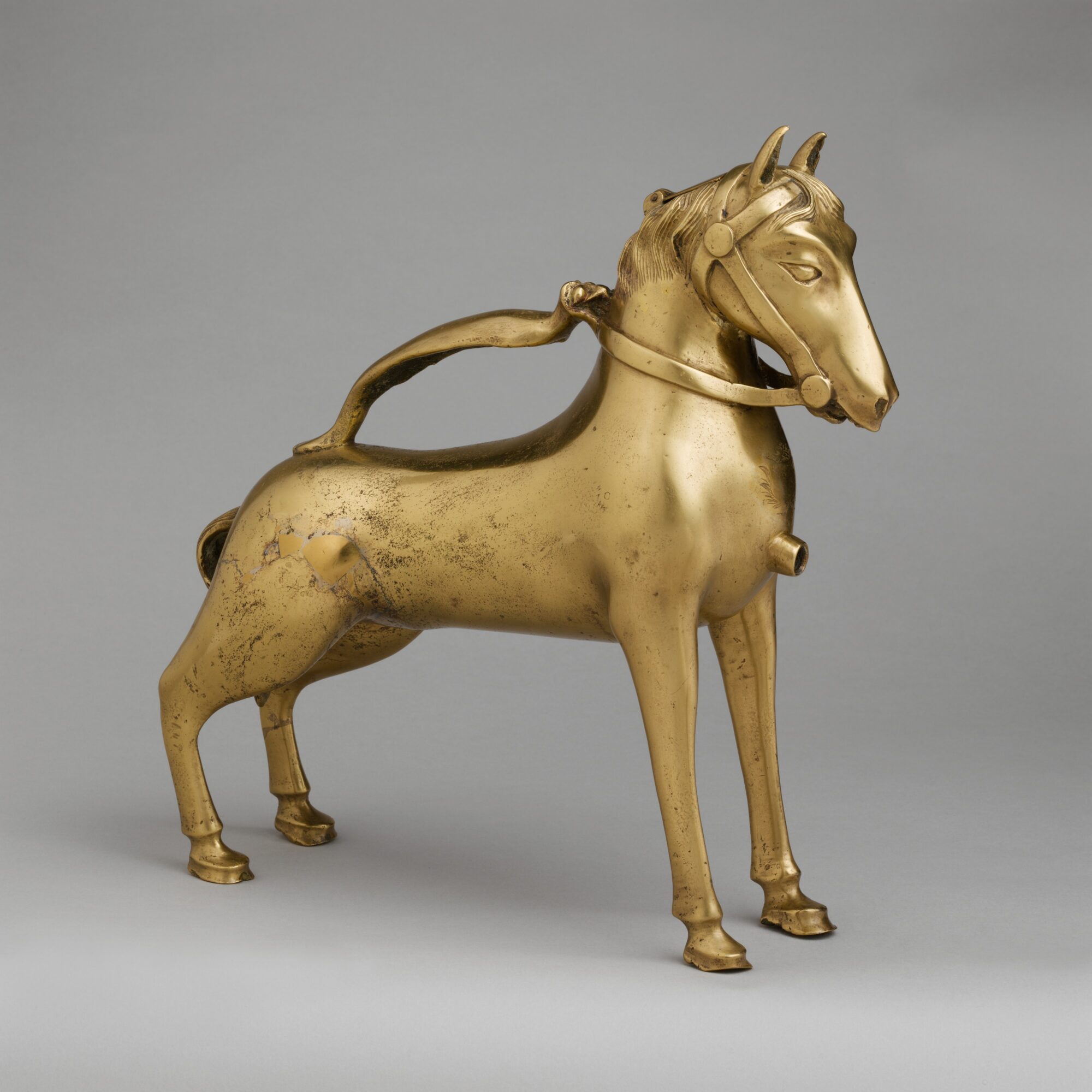
Horse aquamaniles in the form of horses/ 15th century/ Copper Alloy / Met Museum/ PD
An aquamanile is a vessel from which water is poured for hand-washing in both domestic and liturgical settings (often relating to formal worship or religious practice). It comes from Latin, aqua being water and manus is hand. The Hunt collection aquamanile dates from the 15th century. The style of the horse is naturalistic, although there is a small dragon that forms the handle, the dragon holds the rein of the horse. There is a lidded opening at the head, whereby water could be poured in, and the spout and spigot (valve) are attached to the breast of the horse.
The quality and style of the aquamanile indicate that it was made in the Bavarian city of Nuremberg.

Horse aquamanile/Metal, Brass (cast)/ 15th century AD/ The Hunt Collection/ PD

Horse aquamanile/Metal,Copper Alloy,Brass (cast)/15th century AD/The Hunt Collection/PD
Below are three examples from the Met Museum, all three examples are from Nuremberg, German and are in the form of a horse.
The first is a finer and more elegant example and is similar to the aquamanile in the Hunt collection but the dragon turns away. When the object was first accessioned it was as a unicorn but it was restored (horn removed) in 1956!

During the medieval period ‘iconographic’ or rings engraved with Saints became popular during the late 14th and 15th centuries popular saints that were depicted were St. Barbara, St. Christopher, and John the Baptist. The Hunt ring is silver but is gilded, it shows Saint Barbara and the tower.
Saint Barbara was revered in the Middle Ages, the veneration of Saint Barbara in Western Europe can be traced to the 9th century. Her martyrdom was due to the miracles that surround her story. Barbara was the only daughter of a rich pagan, who locked her in a tower to shield her from the world. However, she secretly became a Christian, she made three windows in her tower to signify the holy Trinity. When her father discovered that she was Christian her had her tortured, but her wounds miraculously healed. Her father condemned her to be beheaded and when he carried this out he was struck by lightening.

Silver ring | Metal, Silver (gilded) | 15th century AD | The Hunt Collection | PD
Below is a 15th or 16th-century ‘decade ring’ from the collection of the V&A Museum, decade rings are composed of ten knobs joined together, the ten bosses would have allowed the wearer to count the 10 rounds of prayers that made up a ‘decade of the rosary’. This ring has a bevelled head showing a Saint on each side, St Barbara and St Christopher, important saints n the late Middle Ages.

Gold 'decade' ring with an iconographical bezel depicting Saint Barbara and Saint Christopher, inscribed in black lettering 'A MA VYE', England, 1400-1500 ©Victoria and Albert Museum, London
The example below is very similar to the ring in the Hunt collection, St Barbara is shown holding a tower, emblematic of how her father imprisoned her in a tower in which she added three windows to symbolise the Trinity (a belief of the Christian church, God, Father and the Holy Ghost). This ring may have once been further decorated with enamel, it is a small ring that may have been worn by a child or on the upper part of the finger by an adult.

Gold Ring of St Barbara, © The Trustees of the British Museum
These brass plates are collectively called Nuremberg Brass Alms Dishes, however, these dishes were never intended to be used for alms. Dishes were made in Nuremberg and other German cities during the 16th and 17th centuries to be used as domestic dishes as wealthier households tried to emulate the precious metals and precious jewels that were used in royal courts. Households displayed these plates to demonstrate their wealth to guests when they were used as decorative or serving dishes. The first example is from the Hunt Collection, which shows the story of Adam and Eve, surrounded with lettering.

Plate or serving-dish | Metal,Copper Alloy,Bronze | 16th century AD | The Hunt Collection | PD
The example below shows identical imagery to that in the Hunt example. It also shows Adam and Eve with a snake wrapped around the apple tree, the snake symbolising evil or the devil as tempter. This plate picture is also surrounded with text, however, this is thought to have meaning and is possible an epitaph or memorial.

Brass plate, Nuremberg, Gift of W. L. Hildburgh, 1932 1964, Met Museum Collection, Public Domain
The final example is from the Isabella Stewart Gardner Museum in Boston USA. It shows a similar picture but in higher relief than the previous examples. The walls of the garden and the tower behind is clearly visible. The figures of Adam and Eve are more clearly but similarly designed. There is a border of script surrounding the picture but this has not been deciphered. Interestingly, it is thought that many of the inscriptions on these plates are meaningless and were often added purely as decoration.

Brass Adam and Eve Plate, 15th century, Isabella Stewart Gardner Museum, CC BY-NC-ND 4.0 DEED
The museum has a project-focused approach to research, many projects focus on particular themes in the collection and such projects afford the museum the opportunity to research objects in more detail. When new information is found the museum incorporates this into the Explore section of our website.
Sharing digital collections is a primary task for the Hunt Museum collection team, we are actively digitising our collection in high-resolution 2D and 3D, this brings museum objects out of the museum by releasing them into the Public Domain. This opens up our collection to the public, researchers and those in other GLAM (Galleries, Libraries, Archives and Museums) institutions so that information and research can be shared.
Snap! is an on-going project we will continue to publish items from our collection that seem to pop up in other museums!
If you have an object that you would like to share email us collections@huntmuseum.com.
If looking for one of our objects, please click here
